


Why Do We Need a Switch Disconnector and What Is It?
Why Do We Need a Switch Disconnector and What Is It?
A switch disconnector is an essential switching device in high-voltage and low-voltage power distribution systems. It is a switching device used to isolate electrical circuits and is typically used to disconnect the circuit from the power supply, ensuring the safety of the distribution system during inspection, maintenance, and fault handling.
Under normal working conditions, a switch disconnector has a limited arc-extinguishing capability. It is mainly used to reliably isolate electrical equipment that requires maintenance from the live power grid, ensuring the personal safety of maintenance personnel.
Key Features of “Isolator”:
Power isolation: It creates electrical isolation between equipment under maintenance and the live system, providing a safe maintenance environment.
Visible disconnection point: After the contacts are opened, a clear gap can be seen, allowing intuitive judgment of whether the circuit is disconnected. This is the most fundamental difference compared with circuit breakers.
Switching operation: In systems such as double busbar systems, it is used to change the operating connection mode.
Small current switching: It can switch small current circuits such as voltage transformers, surge arresters, and no-load busbars.
Simple structure: It consists of contacts, an operating mechanism, insulating supports, and a base, ensuring reliable insulation after
Key Features of “Switch Disconnector”:
Load switching: It can safely connect and disconnect the rated working current.
Safe isolation: After disconnection, it provides a clearly visible isolation point and sufficient insulation distance, meeting maintenance safety requirements.
Switch structure: It adopts a double-break and parallel contact structure, providing good conductivity.
Installation and operation: It supports various installation methods such as inside/outside cabinets, front/side mounting, and front/rear panel installation.
Difference Between Isolator, Switch Disconnector and Circuit Breaker:
Isolator: Provides electrical isolation and a clearly visible disconnection point to ensure personal safety.
Switch disconnector: Based on the isolation function, it can also break load current, combining both control and isolation functions.
Circuit breaker: Under normal conditions, it connects and disconnects load current, and under fault conditions, it automatically cuts off the short-circuit current.
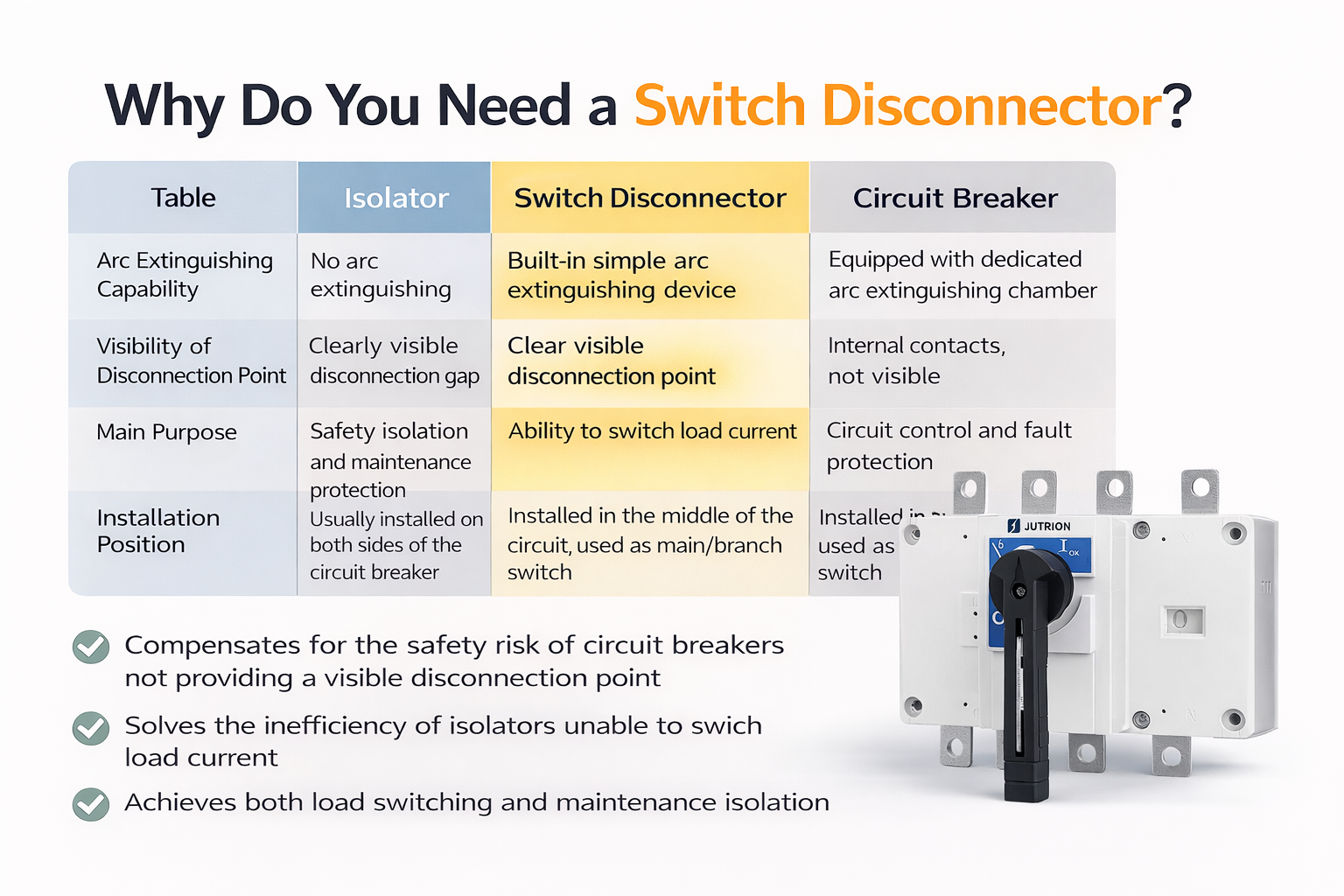
Item | Isolator | Switch Disconnector | Circuit Breaker |
Arc Extinguishing Capability | No arc extinguishing device | Built-in simple arc extinguishing device | Equipped with dedicated arc extinguishing chamber |
Visibility of Disconnection Point | Clearly visible disconnection gap | Visible disconnection point | Internal contacts, not visible |
Main Purpose | Safety isolation and maintenance protection | Load switching and maintenance isolation | Circuit control and fault protection |
Installation Position | Usually installed on both sides of the circuit breaker | Installed in the middle of the circuit, used as main/branch switch | Installed in the middle of the circuit, used as protection switch |
Why Do We Need a Switch Disconnector?
After introducing the differences between isolators, switch disconnectors, and circuit breakers, next I will explain why we need it.
In practical applications, although a circuit breaker can realize circuit switching and fault protection, it cannot provide a clearly visible disconnection point. After opening, the internal contacts are separated, and there is no way to visually confirm whether the circuit is completely disconnected, which may bring great safety risks to maintenance personnel.
Although an isolator has a reliable isolation disconnection point, it cannot operate under load. Each switching operation requires disconnecting the upstream circuit breaker, making the operation complicated and inefficient, and unable to meet the needs of frequent start-stop and circuit switching in daily use.
A switch disconnector can directly connect and disconnect the rated load current without additional power-off operations, greatly improving the start-stop efficiency of the circuit. During maintenance, it provides a visible disconnection point, allowing intuitive observation of whether the circuit is de-energized, achieving both convenient operation and safe maintenance.
In summary:
A switch disconnector is an essential product in power distribution systems. It not only solves the safety risk of circuit breakers lacking a visible disconnection point, but also compensates for the shortcomings of isolators that cannot operate under load and have low efficiency, achieving both load switching in daily operation and safe isolation during maintenance.
FAQs:
Q:Can a switch disconnector replace a circuit breaker?
A:No. A switch disconnector does not have overload and short circuit protection functions. It can only be used for load switching and isolation, and must be used together with a circuit breaker.
Q:Why install a switch disconnector if a circuit breaker is already installed?
A:Frequent load switching with a circuit breaker will accelerate wear of the arc chamber and contacts, shortening its service life. A switch disconnector can handle daily start-stop and circuit switching operations, helping to extend the service life of the circuit breaker.
Q:How to choose the poles (3P/4P) of a switch disconnector?
A:For standard three-phase distribution systems, the neutral line does not need to be disconnected (choose 3P). For dual power switching, IT/TT systems, or leakage protection circuits, it is recommended to choose 4P.
-
What Is a Surge Protective Device?
2025-10-29 11:05:09 -
How Can a Miniature Circuit Breaker Achieve Remote ON/OFF Control?
2025-12-29 11:05:09 -
How to Select the Right AC Contactor for Electrical Systems?
2026-01-29 20:26:49 -
What Is an Automatic Transfer Switch (ATS) and How to Select the Right One?
2025-11-02 11:05:09 -
Why Do We Need a Switch Disconnector and What Is It?
2026-03-31 23:29:08