


What Is an MCCB (Molded Case Circuit Breaker)? Types, Functions and Applications
#Industry information ·2025-12-03 19:29:30
What Is an MCCB (Molded Case Circuit Breaker)?
A Molded Case Circuit Breaker (MCCB) is a key protective device widely used in low-voltage power distribution systems. It is designed to protect electrical circuits and connected equipment against overloads, short circuits, and ground faults. MCCBs are suitable for applications with higher current ratings, more complex system structures, and higher requirements for operational reliability, making them an indispensable component in industrial, commercial, and residential power distribution systems.
MCCBs are generally classified into thermal-magnetic types and electronic trip types. Under conventional operating conditions, thermal-magnetic MCCBs are the most commonly used. Owing to their simple structure, high reliability, moderate cost, and ease of maintenance, thermal-magnetic MCCBs have become the preferred choice for routine industrial, commercial, and residential distribution applications. They are also the most widely applied type, covering almost all basic scenarios of general power distribution and standard equipment protection.
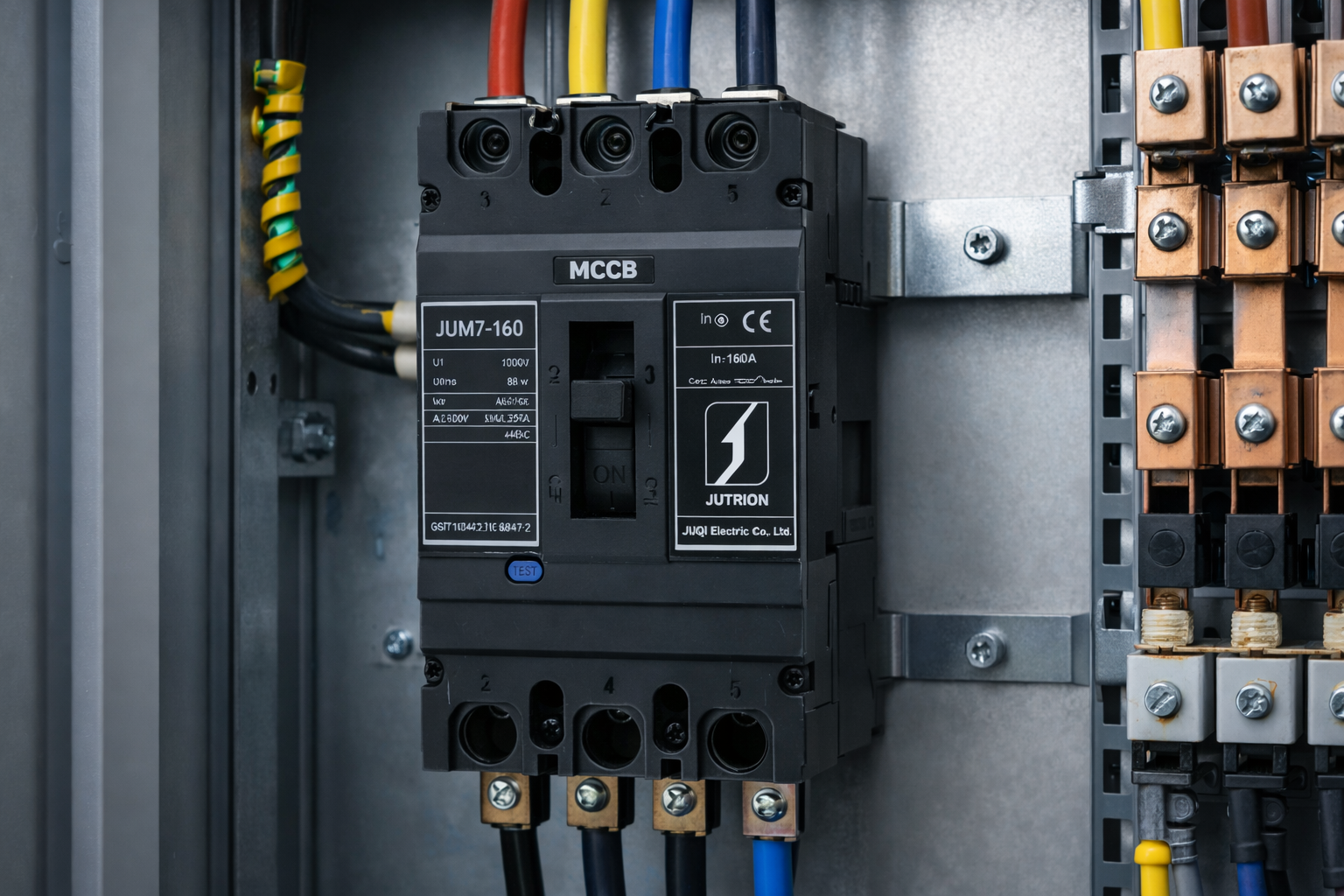
Working Principle and Applications of Thermal-Magnetic Molded Case Circuit Breakers
A thermal-magnetic circuit breaker is a low-voltage protective device that provides overload protection and short-circuit protection through a dual mechanism consisting of a thermal trip and a magnetic trip. It is the most basic, widely used, and cost-effective type of circuit breaker.
Working Principle:
- Thermal Trip:A bimetal strip is installed inside the breaker. When the current exceeds the rated value, heat is generated, causing the bimetal strip to bend. Once the deformation reaches a preset level, it actuates the trip mechanism and causes the circuit breaker to trip.
- Magnetic Trip:An electromagnetic coil and armature are connected in series with the main circuit. In the event of a short circuit, the current rises sharply, generating a strong magnetic field that instantly attracts the armature and triggers immediate tripping.
Applications:
- Thermal-magnetic molded case circuit breakers feature a stable and durable design with excellent cost performance. They do not require complex parameter settings while still meeting standard overload and short-circuit protection requirements. Typical applications include residential buildings, office complexes, factories, and data center infrastructure projects. They are commonly used for main circuit and branch circuit protection in power distribution panels and control cabinets.
Working Principle and Applications of Electronic Molded Case Circuit Breakers
An electronic molded case circuit breaker uses an electronic sensing and control unit as its core, converting electrical signals into mechanical actions. Compared with traditional thermal-magnetic detection based purely on mechanical and electromagnetic principles, electronic MCCBs offer higher protection accuracy and greater functional expandability.
Working Principle:
Current transformers or shunt resistors installed in the main circuit continuously monitor the current and convert high current levels into low-level electrical signals that can be processed by the electronic unit. These signals are amplified and filtered by the electronic control unit and compared with preset protection parameters to determine the type of fault, such as overload, short-time delay short circuit, instantaneous short circuit, or ground fault.Based on the fault evaluation, the control unit outputs the corresponding trip signal, driving the electronic trip actuator to generate electromagnetic force. This force actuates the mechanical trip lever, releasing the mechanical latch. The stored-energy spring then drives the main contacts to open rapidly, while the arc chute extinguishes the arc, thereby interrupting the faulty circuit.
Applications:
- Electronic molded case circuit breakers are designed for low-voltage power distribution systems with high requirements for protection accuracy, selective coordination, and functional expandability. Typical applications include industrial power distribution, renewable energy systems, large commercial buildings, and intelligent power distribution systems, where precise protection and advanced system management are required.
Thermal-Magnetic MCCBs vs. Electronic MCCBs
In practical applications, molded case circuit breakers (MCCBs) are mainly classified into thermal-magnetic types and electronic types based on their tripping mechanisms. Each type offers distinct technical characteristics and performance advantages, making them suitable for different power distribution protection requirements.
Thermal-magnetic molded case circuit breakers feature a classic design based on purely mechanical and electromagnetic principles. With high reliability and excellent cost performance, they are widely used in conventional industrial, commercial, and residential power distribution systems and remain one of the most commonly applied and proven solutions in the low-voltage distribution field.
Electronic molded case circuit breakers provide higher protection accuracy, adjustable protection parameters, and enhanced functional expandability. They are particularly well suited for demanding power distribution environments such as renewable energy systems, data centers, and large commercial or infrastructure projects, where comprehensive and precise protection is required.
| Item | Thermal-Magnetic MCCB | Electronic MCCB |
| Type | Thermal element for overload, magnetic element for short circuit | Electronic sensing and microprocessor-based protection |
| Response Speed | Mechanical response | Fst and precise electronic response |
| Reliability | High, simple structure | High, depends on power supply |
| Application Scenario | General industrial, commercial, residential distribution | Data centers, renewable energy, critical power systems |
FAQs
Q: Is it necessary to use electronic molded case circuit breakers in ordinary industrial projects?
A:In most cases, it is not necessary. For industrial projects with stable load characteristics and relatively low protection requirements, thermal-magnetic molded case circuit breakers are sufficient to meet basic overload and short-circuit protection needs. Using electronic MCCBs may increase project costs, and some advanced functions may not be fully utilized in such applications.
Q: Why are electronic molded case circuit breakers commonly required in large-scale projects?
A:Large-scale projects usually have higher requirements for protection accuracy, system stability, and equipment safety, and the value of the protected equipment is typically higher. Electronic molded case circuit breakers offer adjustable parameters and higher protection precision, which help reduce the risk of nuisance tripping and minimize losses caused by equipment damage or unexpected downtime.
Q: Are electronic molded case circuit breakers always better than thermal-magnetic molded case circuit breakers?
A:Not necessarily. The choice depends on the actual application scenario, power distribution requirements, and operating environment. Different technologies are designed to meet different protection needs. Electronic MCCBs are more suitable for high-demand and complex distribution systems, while thermal-magnetic MCCBs are often more practical for standard applications and harsh operating environments.
-
What Is a Surge Protective Device?
2025-10-29 11:05:09 -
How Can a Miniature Circuit Breaker Achieve Remote ON/OFF Control?
2025-12-29 11:05:09 -
How to Select the Right AC Contactor for Electrical Systems?
2026-01-29 20:26:49 -
What Is an Automatic Transfer Switch (ATS) and How to Select the Right One?
2025-11-02 11:05:09 -

What Is an Arc Fault Protection Device?
2026-03-18 00:00:24