


DC Surge Protective Devices for Solar PV Systems: Why the 600V/1000V/1500V Rating Matters?
As the scale of solar photovoltaic (PV) systems and Energy Storage Systems (ESS) continues to expand, the requirements for surge protection have become increasingly stringent. If core equipment such as inverters, battery banks, combiner boxes, and DC distribution panels are subjected to lightning strikes or switching surges, it can lead to severe equipment damage, costly downtime, and critical safety hazards. Specifying the correct DC SPD is absolutely vital to ensuring the long-term, stable operation of your solar and energy storage assets.
Common Voltage Ratings for PV DC Surge Protective Devices
| DC SPD Voltage Rating | Common Applications |
| 500V DC | Small low-voltage DC systems; rarely used in mainstream PV applications. |
| 600V DC | Early or small-scale residential PV systems; commonly seen in the North American market. |
| 800V DC | Rare; used in specific, specialized DC systems. |
| 1000V DC | Highly common in residential and Commercial & Industrial (C&I) PV systems. |
| 1200V DC | Transitional or specialized systems; less common than 1000V or 1500V. |
| 1500V DC | The mainstream standard for utility-scale solar farms and large C&I PV projects. |
600V, 1000V, 1500V: The Evolution of PV Voltages and Their Applications
This section will explain in detail how solar photovoltaic (PV) systems have evolved across these three different voltage levels ("voltage evolution"), and the real-world engineering projects where each voltage class is deployed ("application scenarios").
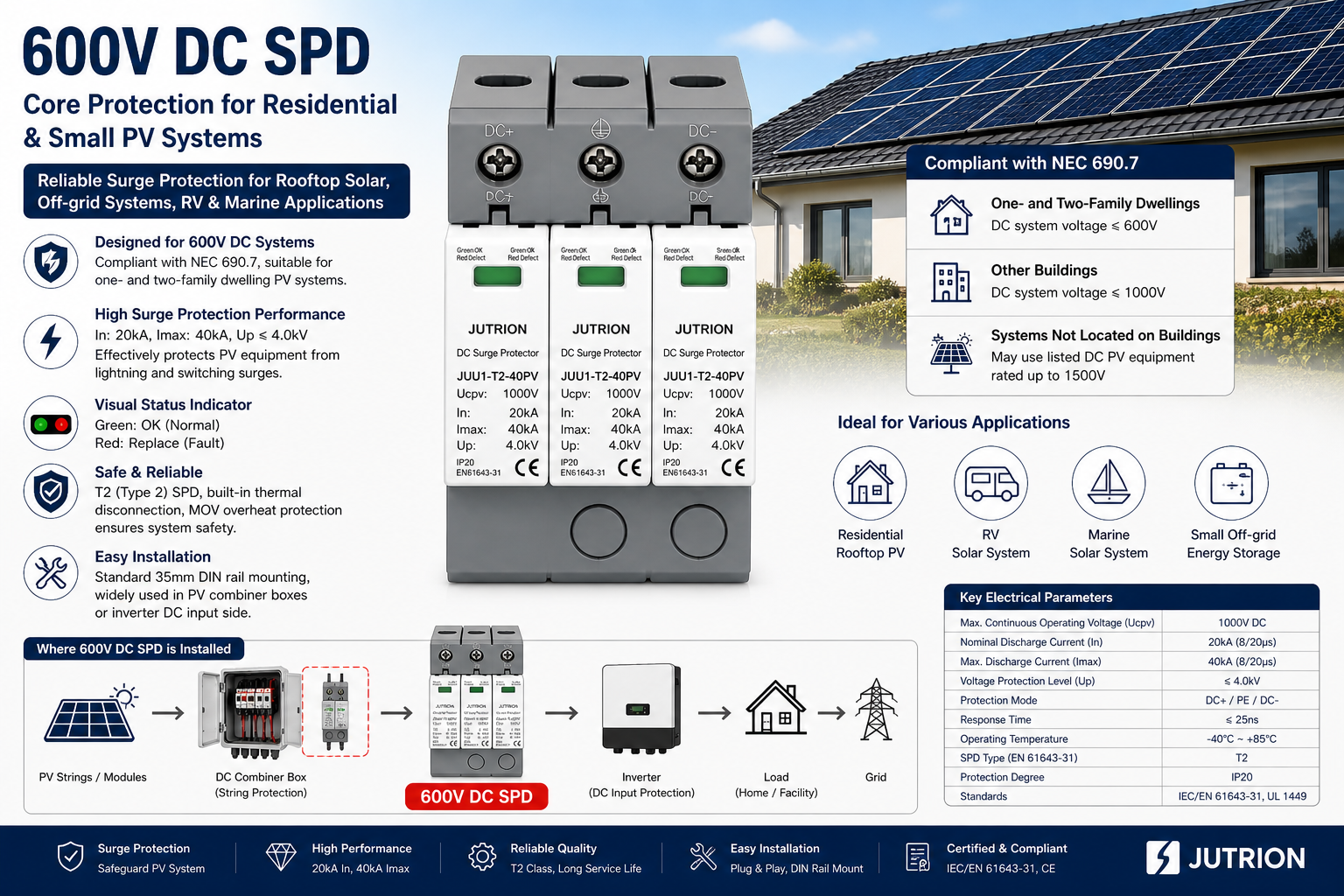
600V DC SPD: Core Application Scenarios
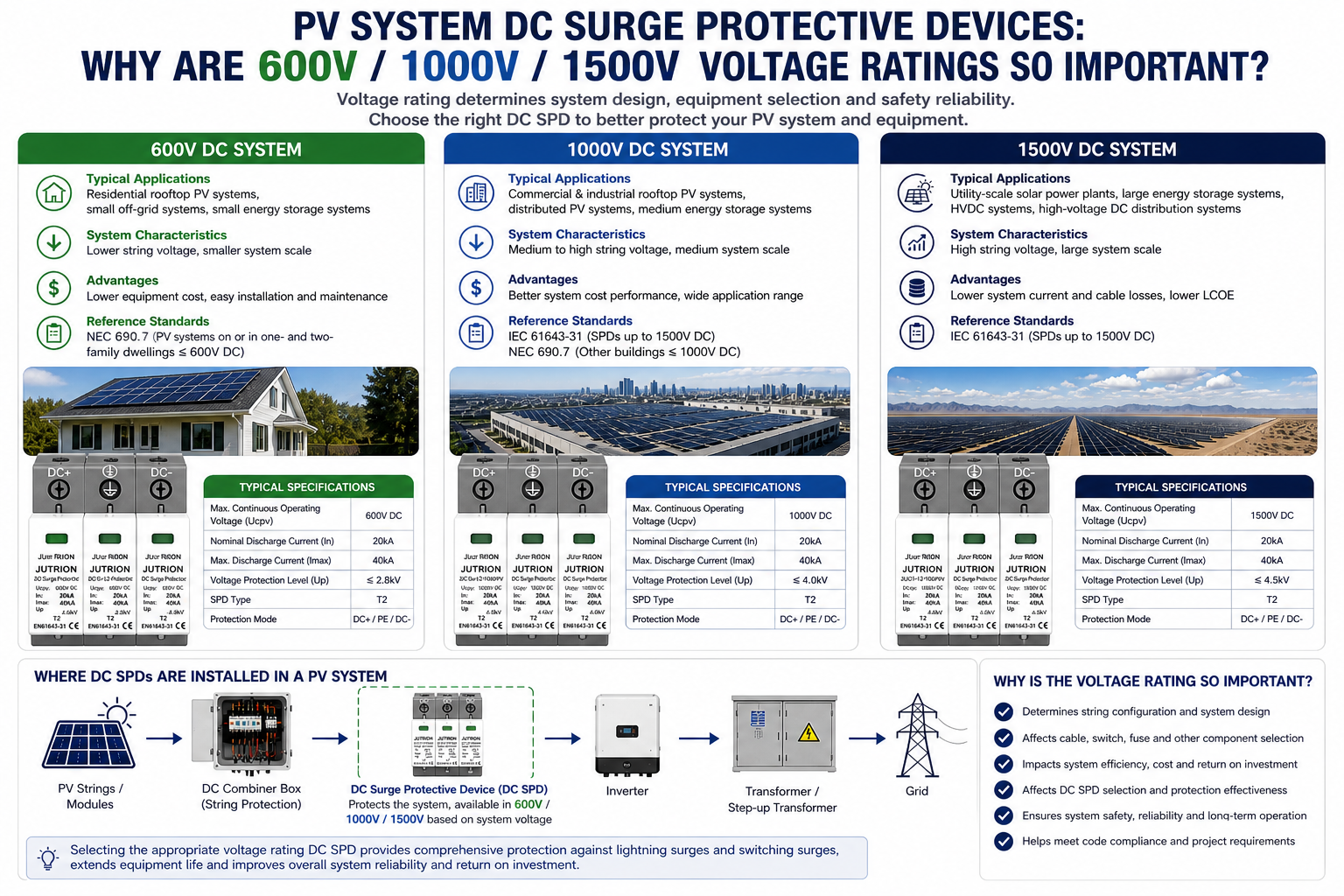
The primary battleground for 600V DC SPDs includes residential rooftop solar, small off-grid energy storage systems (ESS), and RV/marine solar retrofit projects. Especially in the North American market, residential buildings are subject to extremely strict fire and electrical safety regulations under the National Electrical Code (NEC 690.7). Consequently, the maximum DC-side system voltage for most PV systems installed on single-family residential rooftops is strictly mandated not to exceed 600V. Additionally, 600V remains the most common voltage rating in many early micro-inverter systems and legacy PV retrofits.
Engineering Tip: When selecting a 600V DC SPD, do not merely look at the nominal voltage and price tag. Engineers must evaluate critical performance parameters, including Ucpv, In, Imax, Up, IP ratings, certification standards, and the internal thermal disconnect design. As the MOV (Metal Oxide Varistor) endures long-term surge impacts or naturally ages, a premium SPD can safely isolate the failing module via its thermal disconnect mechanism, thereby significantly mitigating the risks of overheating and sustained faults.
1000V DC SPD: Core Application Scenarios
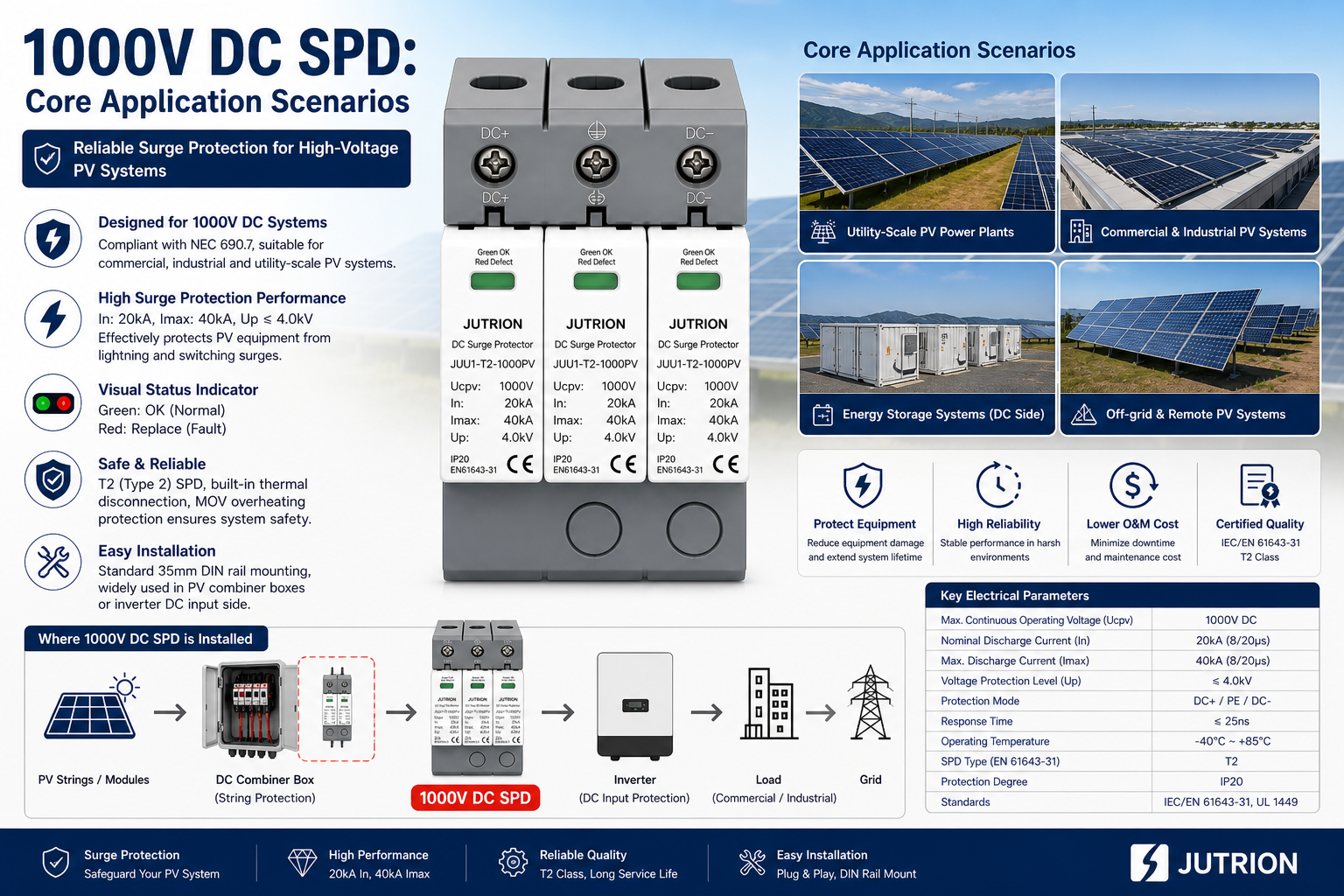
The 1000V DC system is currently the absolute backbone of global Commercial & Industrial (C&I) solar. You will find 1000V architectures dominating factory rooftops, large logistics park solar carports, medium-scale ground-mount solar farms, and the outdoor DC side of Commercial Battery Energy Storage Systems (BESS). Compared to 600V, a 1000V architecture reduces string counts by approximately 40% for the same plant capacity, saving massive amounts of copper cabling costs. It is the golden standard that strikes a perfect balance between "construction cost" and "maintenance safety."
Engineering Tip: Most 1000V combiner boxes are exposed on metal roofs, where summer temperatures inside the enclosure can soar to 70°C. Meanwhile, extreme winter cold snaps will cause the open-circuit voltage (Voc) of PV modules to spike. If the maximum continuous operating voltage you select is exactly 1000V, the MOV (Metal Oxide Varistor) will operate in a constant state of overstress during winter cold starts or prolonged summer heat. This accelerates aging and easily triggers combiner box fires. For 1000V systems, the SPD must have a sufficient engineering safety margin (typically recommending 1200V or 1300V). Additionally, ensure the procured SPD features a superior UL94 V-0 flame-retardant housing and a precise internal mechanical thermal disconnect.
1500V DC SPD: Core Application Scenarios
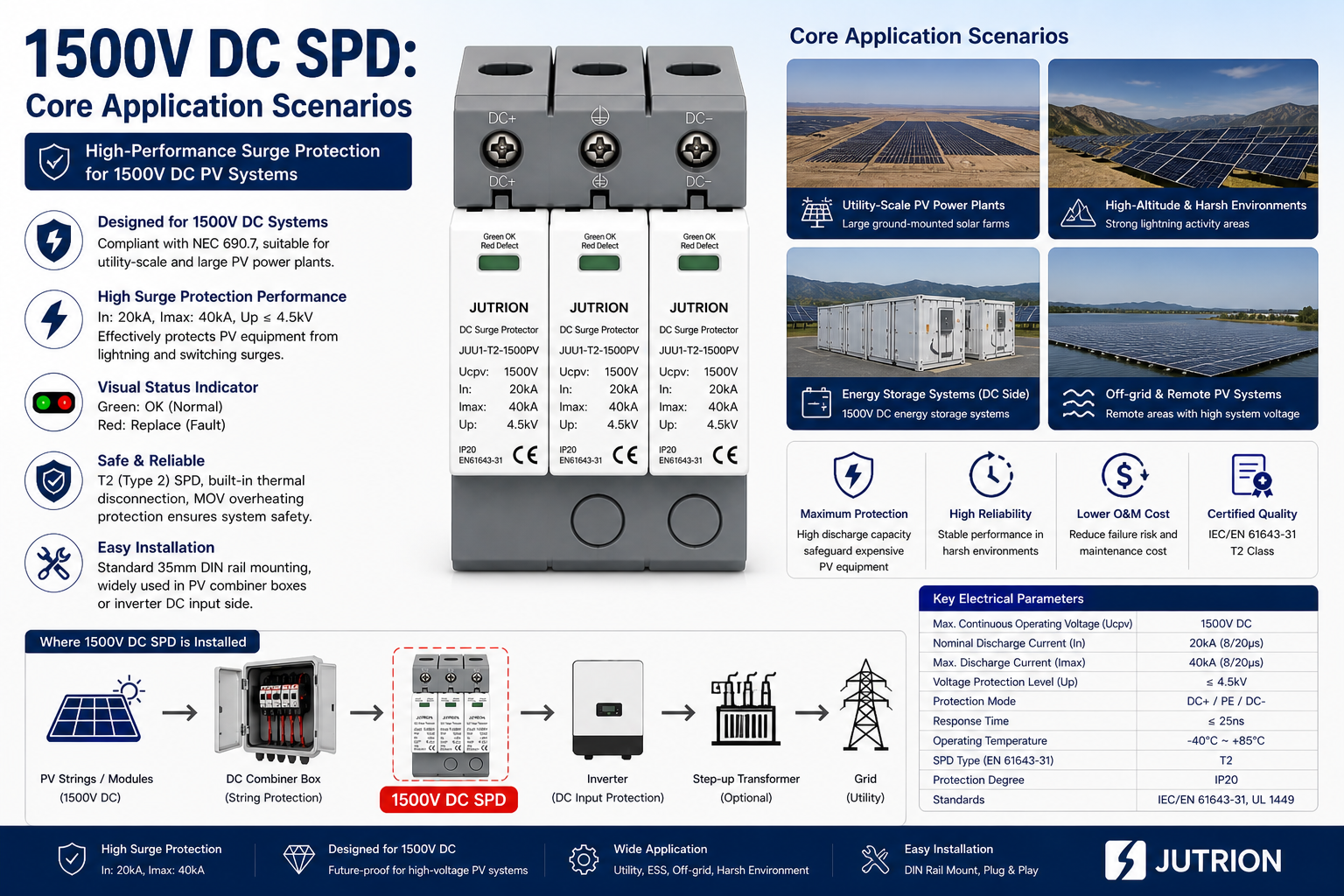
The 1500V DC architecture is the standard configuration for global utility-scale solar farms and megawatt-level electrochemical energy storage systems (BESS). By pushing the string voltage to 1500V, power plants can significantly reduce the number of combiner boxes and drastically minimize cable losses caused by high currents. However, 1500V poses extremely stringent clearance and creepage distance requirements for all components within the system, especially the SPD responsible for surge protection.
Engineering Tip: Unlike AC, DC has no "zero-crossing" point. Under the extreme voltage of 1500V, once the SPD's MOV fails, the resulting electrical arc is incredibly difficult to extinguish. If the SPD's internal mechanical disconnect is not well-engineered, or the arc chutes fail to quickly break the arc, the sustained arc will generate temperatures of thousands of degrees, instantly incinerating the entire 1500V combiner box. You must ensure the 1500V SPD features a dedicated Arc-extinguishing Chamber and a robust mechanical separation mechanism. During procurement, always demand safety test certifications from the manufacturer proving safe disconnection under extreme 1500V overvoltage conditions.
Global PV Voltage Requirements and Market Practices
- North America: 600V for Residential, 1000V/1500V for Larger PV Systems
- In North America, 600V DC is commonly associated with one- and two-family residential PV systems. According to NEC 690.7, PV system DC circuits on or in one- and two-family dwellings are permitted up to 600V, while PV systems on or in other buildings may be up to 1000V. For systems not located on or in buildings, listed DC PV equipment rated up to 1500V may be used. This is why 600V DC SPDs are still common in residential rooftop solar, while 1000V and 1500V DC SPDs are more suitable for commercial, industrial, and utility-scale PV projects.
- Europe: 1000V and 1500V Are Widely Used in Commercial and Utility PV
- In Europe, 1000V DC and 1500V DC systems are widely used depending on the project scale. Residential and small commercial PV projects often use 1000V-class equipment, while large ground-mounted solar farms commonly adopt 1500V DC architecture to reduce current, cable losses, and balance-of-system cost. For PV surge protection, IEC 61643-31 applies to SPDs connected to the DC side of photovoltaic installations rated up to 1500V DC, which makes 1500V DC SPD selection a common requirement for large PV projects.
Australia and New Zealand: 1000V for Domestic, 1500V for Non-Domestic Installations
In Australia and New Zealand, AS/NZS 5033:2021 changed the voltage limits for PV arrays. The calculated PV maximum voltage for domestic electrical installations is limited to 1000V DC, while non-domestic installations may be up to 1500V DC. This means 1000V DC SPDs are common in residential PV systems, while 1500V DC SPDs are used more often in commercial, industrial, and utility-scale projects.
Middle East: 1500V Is Common in Large Solar Farms
In the Middle East, especially in large desert solar farms and utility-scale PV projects, 1500V DC systems are commonly used because they help reduce current, cable losses, and installation cost over long DC cable runs. However, it is better to describe this as a market practice rather than a universal regulation. For rooftop and smaller commercial projects, 1000V DC may still be used depending on the inverter, project design, and local authority requirements.
Southeast Asia: 1000V for Rooftop PV, 1500V for Large Solar Farms
In Southeast Asia, 1000V DC is commonly used in residential, commercial rooftop, and small industrial PV systems. For larger ground-mounted solar farms, 1500V DC systems are increasingly used to improve system efficiency and reduce balance-of-system cost. Because regulations and grid connection requirements vary by country, buyers should confirm the allowed PV system voltage with the local project consultant or utility company before selecting DC SPDs.
Latin America: 1000V and 1500V Both Exist, Depending on Project Scale
In Latin America, both 1000V DC and 1500V DC PV systems are used. Rooftop and commercial projects often use 1000V-class components, while large solar farms in countries with strong utility-scale PV development may adopt 1500V DC system designs. For exporters and EPC buyers, the safest approach is to prepare both 1000V and 1500V DC SPD options to match different project requirements.
Africa: 600V/1000V for Small Systems, 1500V for Utility Projects
In Africa, system voltage varies greatly by project type. Small off-grid solar systems, telecom solar sites, rural power systems, and mini-grid projects may use lower voltage classes such as 600V or 1000V DC. Large utility-scale solar farms, especially projects developed by international EPC companies, may use 1500V DC system architecture. For this market, DC SPD selection should be based on the inverter specification and maximum PV string voltage, not only the country name.
Final Professional Advice: While voltage rating is the starting point, the true reliability of a DC SPD lies in its internal safety margins and material quality. At JUTRION, we don't just provide components; we provide long-term security for your renewable energy investment.
-
What Is a Surge Protective Device?
2025-10-29 11:05:09 -
How Can a Miniature Circuit Breaker Achieve Remote ON/OFF Control?
2025-12-29 11:05:09 -
How to Select the Right AC Contactor for Electrical Systems?
2026-01-29 20:26:49 -
What Is an Automatic Transfer Switch (ATS) and How to Select the Right One?
2025-11-02 11:05:09 -
DC Surge Protective Devices for Solar PV Systems: Why the 600V/1000V/1500V Rating Matters?
2026-05-05 22:33:16